
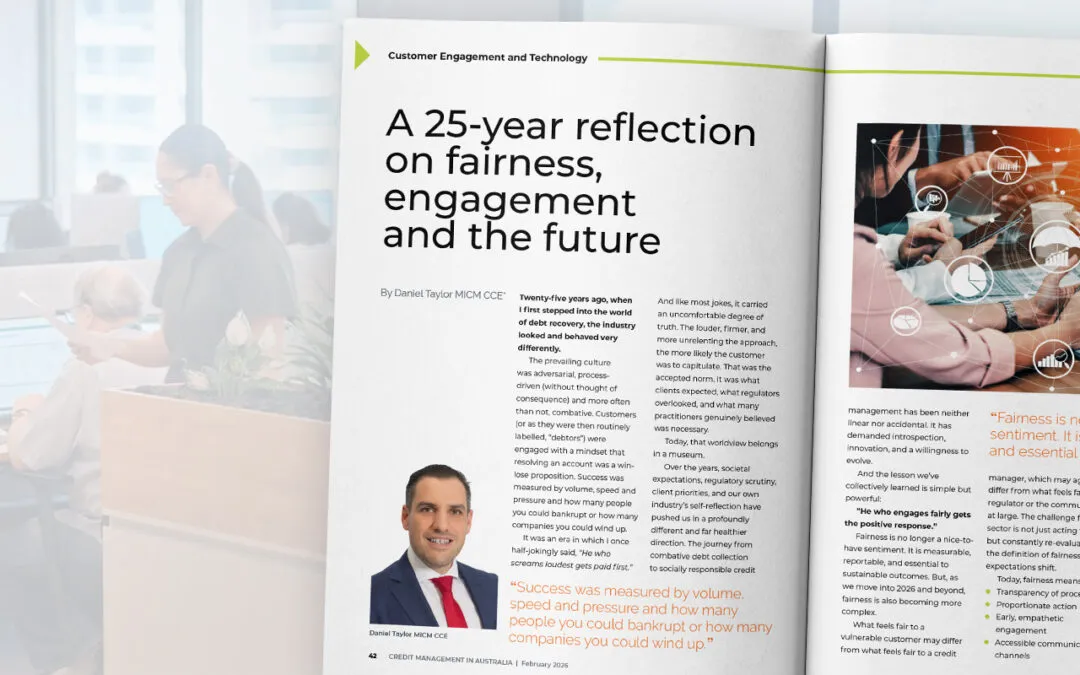
By Daniel Taylor MICM CCE
Twenty-five years ago, when I first stepped into the world of debt recovery, the industry looked and behaved very differently.
The prevailing culture was adversarial, processdriven (without thought of consequence) and more often than not, combative. Customers (or as they were then routinely labelled, “debtors”) were engaged with a mindset that resolving an account was a winlose proposition. Success was measured by volume, speed and pressure and how many people you could bankrupt or how many companies you could wind up.
It was an era in which I once half-jokingly said, “He who screams loudest gets paid first.” And like most jokes, it carried an uncomfortable degree of truth. The louder, firmer, and more unrelenting the approach, the more likely the customer was to capitulate. That was the accepted norm. It was what clients expected, what regulators overlooked, and what many practitioners genuinely believed was necessary.

Success was measured by volume, speed and pressure and how many people you could bankrupt or how many companies you could wind up.
Today, that worldview belongs in a museum. Over the years, societal expectations, regulatory scrutiny, client priorities, and our own industry’s self-reflection have pushed us in a profoundly different and far healthier direction. The journey from combative debt collection to socially responsible credit management has been neither linear nor accidental. It has demanded introspection, innovation, and a willingness to evolve.
And the lesson we’ve collectively learned is simple but powerful: “He who engages fairly gets the positive response.” Fairness is no longer a nice-to have sentiment. It is measurable, reportable, and essential to sustainable outcomes. But, as we move into 2026 and beyond, fairness is also becoming more complex.
Fairness is no longer a nice-to-have sentiment. It is measurable, reportable, and essential
to sustainable outcomes
What feels fair to a vulnerable customer may differ from what feels fair to a credit manager, which may again differ from what feels fair to a regulator or the community at large. The challenge for our sector is not just acting fairly, but constantly re-evaluating the definition of fairness as expectations shift.
Today, fairness means:
- Transparency of process
- Proportionate action
- Early, empathetic engagement
- Accessible communication channels
- Recognition of vulnerability
- Pathways to sustainable resolutions
Fairness is not just ethical it is efficient. The data consistently shows that customers who feel heard and respected resolve debt faster and more sustainably. Engagement drives outcomes. Humanity drives engagement.
The phrase “social responsibility” can sound abstract, but in our industry it is refreshingly practical.

The modern credit professional must be part technologist, part risk manager, part behavioural economist, and part social scientist.
It means designing credit and recovery frameworks that acknowledge the lived reality of the people we serve. It means balancing commercial imperatives with empathy. It means recognising that the purpose of credit is to create opportunity, not hardship and the purpose of recovery is to restore balance, not inflict harm.
In practice, socially responsible credit management includes:
- Using behavioural insights to shape respectful conversation
- Offering flexible digital and human channels
- Ensuring hardship pathways are genuine, accessible and stigma-free
- Training staff not just in compliance, but in emotional intelligence
- Monitoring outcomes beyond dollars recovered
Across the last decade, digital transformation has become a foundational pillar of our evolution. AI-driven analytics, voice-AI, omnichannel communication, and customer centric platforms are enabling precision and personalisation that would have been unthinkable early in my career.
But the risk and the responsibility lie in how we use this technology. Socially responsible credit management requires that digital tools strengthen fairness, not dilute it. AI cannot be allowed to create new inequities or harden old biases. Automation should support better conversations, not replace the human capacity for empathy and judgement.
Used appropriately, technology provides:
- Earlier detection of hardship
- Smarter segmentation
- More tailored communication
- Safer governance and auditability
- Reduced friction for customers seeking help
Technology amplifies fairness when it is implemented with intention.
Perhaps the most confronting reality for all of us in the profession is that fairness is not static.
Community expectations evolve. Regulatory frameworks tighten. Lived experiences shift. What was acceptable in 2020 may be questionable today and unacceptable in 2027.
Our challenge is not only to meet the standard, it is to anticipate it.
The modern credit professional must be part technologist, part risk manager, part behavioural economist, and part social scientist. We must move in step with societal change, not behind it. After 25 years in this industry, I am proud of how far we’ve come. Proud that we have shed outdated approaches. Proud
that we now view customers as partners in resolution, not opponents in conflict. Proud that fairness and social responsibility are no longer aspirational, they
are operational.
Our profession has matured, and with that maturity comes greater purpose. Credit is the engine that keeps households and businesses moving. Recovery
is the mechanism that keeps that engine sustainable. By anchoring our work in fairness, respect and responsibility, we not only achieve better outcomes, we strengthen the trust on which the entire credit ecosystem relies.
The next chapter of socially responsible credit management is ours to shape. And the industry we build today will define the expectations of tomorrow.
Daniel Taylor MICM CCE
CEO – CCSG Group of Companies
Board Member – Australian Institute of Credit Management
www.ccsgroup.com.au